Space Station Digital Twin Research Lab
The practical R&D environment for space station digital twins: physics-based models, simulations, experiments and verification evidence, addressing real engineering challenges.
- 01Startup Idea
- 02Industry Problem
- 03Engineering Project
- 04Simulation / Prototype
- 05Evidence
- 06Research Outcome
iTelematics® · Space Research
Space Digital Twin
Learn to Protect Missions.
Build Systems That Protect Spacecraft.
- Physics-based
- Mathematical models
- Data-driven
- AI health monitoring Planned
- Cybersecurity Planned
Explore. Experiment. Understand.
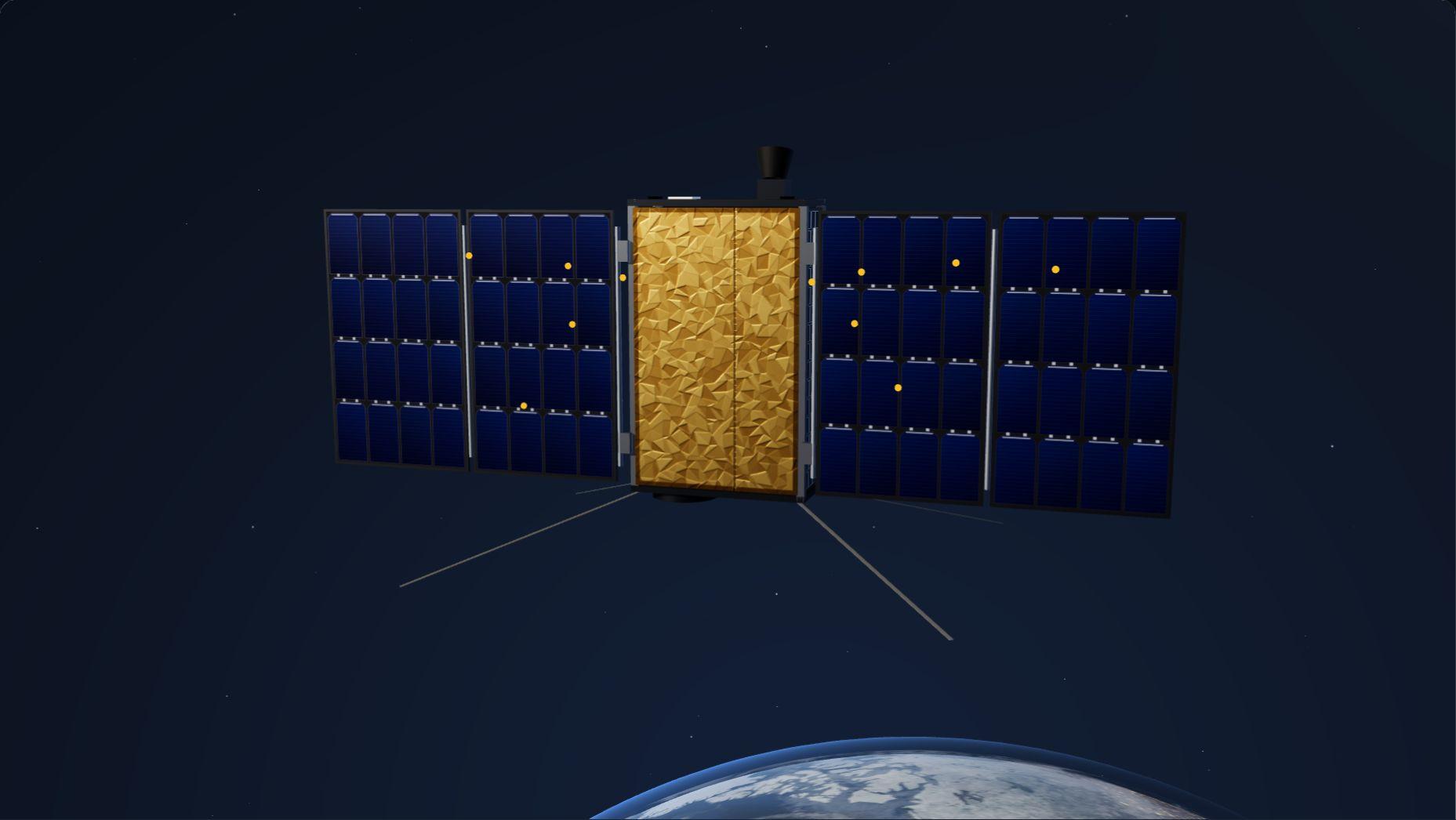
Pick a subsystem, or click it on the model.
Satellite, stage 1 of 4: Spacecraft reveal
Model assumptions and limits
- 550 km circular orbit, β ≈ 20°: 95.6-minute orbit with 34.8 minutes of eclipse (cylindrical shadow).
- Orbit-average array power 41.8 W in sunlight; loads 22 W in sunlight and 14 W in eclipse (payload off); η_EPS 0.9, charge efficiency 0.95, 86 Wh battery.
- Fault: the published heater-stuck scenario (+6 W). Detection is a rule: SOC more than 0.8 percentage points below the model's prediction.
- Safe mode turns the payload off in every phase (14 W). Orbit margin: nominal +20.0 %, with the fault −9.1 %, in safe mode +12.8 %. No credit is taken for the sun-pointing attitude.
- The loop restarts from the settled nominal state; the spacecraft model is generic, not flight hardware.
Fault detection and protective actions here are deterministic engineering rules, not trained AI. AI-based anomaly detection, battery-health estimation and quantum-inspired scheduling are planned research.
Explore satellites, spacecraft, orbital constellations and space stations through realistic 3D engineering experiences. Discover how electrical power, energy storage, telemetry, physics, cybersecurity and intelligent health monitoring support space missions.
- 01
Startup Ideas
Identify and develop space station digital twin and spacecraft engineering ideas with commercial or startup potential.
- 02
Industry Requirements
Research aligned with real requirements in station and spacecraft systems, energy, telemetry, health monitoring and mission operations.
- 03
Practical Projects
Build simulations, physics-based models, prototypes, technical workflows and verification evidence.
- 04
Research & Engineering Development
Develop research in the station and spacecraft domains below, from model to evidence.
- Space Station Systems
- Satellite Systems
- Electrical Power Systems / EPS
- Solar Energy
- Battery Energy Storage
- Thermal & Environmental Systems
- Telemetry
- Avionics
- Sensors
- Station & Spacecraft Health Monitoring
- Digital Twins
- Mission Engineering
Research uses simulation, engineering models and educational hardware; nothing is flight-qualified. Taking part does not imply employment, university affiliation, research funding or certification. Scope, format and availability are confirmed when we discuss your research.
Station R&D programmes
Space station digital twin research.
Six programmes, from the two active priorities (energy and health) to directions not yet started. The programmes in detail
- Simulation
Station Energy & Power Systems
Generation, storage and distribution models, energy margins through eclipses and faults, and load priority for critical systems.
- Research
Station Health Intelligence
Residual-based fault detection and isolation, starting with power channels and batteries, with measured detection delay and false alarms.
- Concept
Integrated Digital Twin Research
A modular architecture in which subsystem models share one environment, one data model and one evidence trail.
- Planned
Thermal & Environmental Models
Coupled power–thermal networks and cabin atmosphere mass balances for heat rejection and life-support margins.
- Planned
Autonomous Operations
Decision support with explainable recommendations, verified against safety requirements before any autonomy is claimed.
- Planned
Verification and Mission Assurance
Validation plans, model credibility assessments and traceable engineering evidence for every model.
Research participation
How contributions work.
- Who can contribute
- Engineers, scientists, researchers and students with a relevant technical background, individually or from organisations.
- Required skills
- A grounding in at least one domain (power, thermal, software, modelling, health monitoring or assurance) and the willingness to document your work.
- Typical experiments
- Energy-balance studies, fault detection on simulated telemetry, model coupling, verification of published equations and sensitivity analyses.
- Engineering evidence expected
- A stated hypothesis and assumptions, reproducible code and data, results with uncertainty, and an honest account of limitations.
- Research review
- Each contribution is reviewed for correctness, reproducibility and fit with the programme before it is published or built on.
- Collaboration enquiries
- Describe the problem, your background and the evidence you could bring; scope, format and availability are agreed case by case.
Participation does not automatically imply employment, funding, certification or university affiliation.
Flagship research
Satellite Energy & Telemetry Intelligence
How a spacecraft generates, stores, consumes and reports energy through every orbit.
Foundational spacecraft power and telemetry research supporting the long-term development of Space Station Digital Twin technologies.
- Sun
- Solar Array
- EPS
- Battery
- Loads
- Solar
- 41.8 W
- Battery
- 98.3 %
- Load
- 22.0 W
- Margin
- +15.6 W
Can the satellite generate, store and manage enough energy to complete its mission safely?
- State
- Sunlight
- Solar
- 41.8 W
- Load
- 22.0 W
- Battery
- 98.4 %
- charging
- Margin
- +15.6 W
- surplus
- Link
- Contact
- downlink
6U reference case · simulated values, not flight data
Reference case and assumptions
- Spacecraft
- 6U Earth-observation CubeSat
- Orbit
- 550 km sun-synchronous orbit, β ≈ 20°
- Period
- 95.6 min · sunlight 61 min · eclipse 34.8 min
- Battery
- 2S4P Li-ion, 7.2 V nominal, 86 Wh
- Loads
- 22 W sunlight · 14 W eclipse (payload off)
- Efficiencies
- EPS 0.9 · charge 0.95
Battery state of charge, three orbits
- Sensors
- Onboard computer
- Radio
- Ground
| Parameter | Sunlight | Eclipse | Source |
|---|---|---|---|
| Eclipse state | SUNLIGHT | ECLIPSE | Orbit propagation, sun sensors |
| Solar generation | 41.8 W | 0.0 W | Array voltage and current sensors |
| Battery SOC | 91 % · rising | 89 % · end of eclipse | Coulomb counting with voltage correction |
| Battery voltage | 8.18 V | 8.03 V | Pack voltage sense |
| Battery current | +1.9 A · charging | −1.9 A · discharging | Shunt current sensor |
| Battery temperature | 17 °C | 6 °C · near 5 °C heater threshold | Thermistors on the pack |
| Bus voltage (5 V rail) | 5.01 V | 4.99 V | EPS rail monitors |
| Subsystem load | 22.0 W | 14.0 W · payload off | Per-channel EPS current sensing |
| Telemetry availability | 100 % frames logged | 100 % frames logged | Onboard housekeeping log |
| Sensor health | NOMINAL · all channels | NOMINAL · sun sensors masked | Sensor self-test, cross-checks |
| Orbit energy margin | +20.0 % | +20.0 % | Derived: energy-balance model |
Illustrative reference case · simulated values, not flight data.
- FaultSolar array
- EPS input
- Battery recharge
- Energy margin
Less generation every orbit. The battery no longer recovers fully, so SOC trends down orbit after orbit.
- 1Concept
- 2Research
- 2Simulation
- 0Prototype
- 1Experimental
- 0Validated
- 4Planned
- Research
System architecture
Energy and information paths, subsystem interfaces and the decision loop.
- Research
Reference case & equations
Orbit geometry, eclipse fraction, energy balance, depth of discharge and SOC, published here.
- Simulation
Orbit energy model
The simulation behind this page: sunlight and eclipse, loads, battery SOC and fault scenarios.
- Simulation
CubeTwin energy simulator (v0.01)
Educational prototype: solar generation, loads, battery SOC, voltage and temperature, CSV telemetry export. Open CubeTwin (opens in a new tab)
- Experimental
Fault experiments
Array degradation, stuck-on heater and sensor-fault scenarios.
- Concept
Requirements
Verifiable energy, telemetry and health requirements traced to the architecture.
- Planned
Battery SOH / RUL estimation
Degradation and remaining useful life from telemetry.
- Planned
Health classification
Context-aware nominal / warning / fault logic and anomaly detection.
- Planned
Hardware telemetry
Measured telemetry from an educational flatsat engineering model.
- Planned
Validation
Comparison of models and simulations against independent reference data.
Nothing here is production-ready or flight-qualified. No result is flight evidence.
Limitations and known gaps
- One reference case: no seasonal variation of β angle or eclipse duration.
- Array power is an orbit average; attitude and self-shadowing are not modelled.
- Loads are constant within each phase; ground-pass radio loads are not modelled.
- Battery capacity is fixed: no temperature dependence, ageing, SOH or RUL model yet.
- Nothing is yet calibrated against a physical test article or measured mission data.
Open research questions
- How does eclipse duration affect satellite battery SOC?
- How should loads be prioritised during low-energy conditions?
- How can telemetry identify early battery degradation?
- How should solar-generation uncertainty be represented?
- How can sensor anomalies be distinguished from true subsystem faults?
- How should mission energy margins be calculated?
- How can telemetry support safe-mode decisions?
Review, guide or contribute.
Research and collaboration enquiries are welcome from academia, industry and the global space ecosystem.
Choose your Space Station Digital Twin research.
Tell us your background and the engineering problem you want to work on.