Space Station Research & Development
Space Station Digital Twin R&D Center
Engineering the Intelligence Behind Future Space Stations.
Explore the engineering systems, scientific challenges, research opportunities and digital twin technologies required to understand, design, simulate, monitor and verify future space stations.
- Physics-Based Modelling
- Digital Twin Engineering
- Energy Autonomy
- Integrated Health Intelligence
- Mission Assurance
- 01Understand the System.
- 02Model the Physics.
- 03Investigate the Behaviour.
- 04Verify the Evidence.
The engineering problem
Why space stations need digital twins.
A space station is a long-lived, tightly coupled system that cannot be taken apart to see what is wrong. Trusted models, kept in step with telemetry, are how engineers understand it.
Tightly coupled systems
Power, thermal, life support, avionics and structure share every watt, kilogram and bit. A change in one shows up in the others, often hours later.
Decades of degradation
Arrays lose output, batteries lose capacity and components wear over a service life of 15 years or more. Margins must be tracked, not assumed.
Limited access
Hardware cannot simply be inspected or replaced. Engineers rely on telemetry and models to see what the station is doing and why.
Decisions under time pressure
When a fault occurs, crews and ground teams need trusted predictions of its consequences before they act, not after.
How we use the words
- Digital model
- A static or manually updated digital representation of a system.
- Simulation
- An engineering model that predicts behaviour under defined assumptions.
- Digital shadow
- A representation updated from measured data, without full two-way synchronisation.
- Digital twin
- A system-specific, appropriately synchronised and validated representation with a defined engineering purpose.
By these definitions, nothing on this site is yet an operational digital twin: the station model below is a simulation of a conceptual station.
Vision · 2047
To advance the engineering and operational intelligence of future space stations through trusted digital twins that help make orbital infrastructure safer, more resilient, autonomous and sustainable.
Mission
To research, develop and validate physics-based, data-driven and intelligent digital twin technologies for the design, integration, simulation, health monitoring, fault diagnosis, predictive analysis and operational assurance of space-station systems.
Eight strategic goals.
Each goal has an objective that can be checked.
- 01
Develop modular space-station digital twin architecture.
Objective Define a reference architecture, interfaces and data model that let subsystem twins be added one at a time.
- 02
Build physics-based station subsystem models.
Objective Model power, energy storage, thermal, life-support mass balance and structure from first principles, with stated assumptions.
- 03
Research electrical energy autonomy.
Objective Develop energy management that keeps critical loads powered through eclipses, degradation and faults.
- 04
Advance integrated station health monitoring.
Objective Detect, isolate and explain faults across subsystems, with measured detection delay and false-alarm rates.
- 05
Investigate intelligent and secure station operations.
Objective Research decision support, telemetry integrity and secure commanding, without unproven autonomy claims.
- 06
Enable reproducible scientific experimentation.
Objective Publish experiments with hypotheses, assumptions, code and data so others can reproduce or refute them.
- 07
Establish traceable model validation and mission assurance.
Objective Trace each model from requirement to evidence, with credibility, provenance and uncertainty recorded.
- 08
Build a collaborative engineering research ecosystem.
Objective Work with researchers, engineers and organisations on clearly scoped, reviewable research projects.
Proposed milestones.
Planning targets, not commitments or achievements. Each depends on research results, people and funding.
2027 Planned
Publish the Station Reference Case SRC-1 reference architecture and a verified station energy-balance model; run the five flagship energy and health experiments in simulation with reproducible notebooks.
2029 Planned
Operate a telemetry ingestion and replay service on simulated and hardware-in-the-loop data; couple the power and thermal models; benchmark health-monitoring algorithms with published detection delay and false-alarm rates.
2032 Planned
Demonstrate a multi-subsystem digital twin (power, energy storage, thermal, life-support mass balance, mass properties) validated against laboratory or collaborator data.
2035 Planned
Demonstrate station-level health intelligence on representative data with external R&D collaborators, and publish model credibility assessments.
2047 Planned
Trusted, continuously updated digital twins supporting the design and operation of complex orbital infrastructure, contingent on technical and commercial progress.
Space station systems architecture
Twelve systems. One station.
Select a system to see its purpose, the physics behind it, what it connects to and what it reports, and where digital twins could help. These are research directions: complete twins do not yet exist for any of them.
01Mission Architecture and Orbital Environment
- Purpose
- Defines the orbit, service life, crew and research objectives, and the environment every subsystem must survive.
- Engineering principles
- Requirements flow-down; orbit selection by altitude, inclination and β-angle; atomic oxygen, radiation, micrometeoroids and orbital debris, plasma and thermal cycling; drag and reboost.
- Mathematics and physical models
- Kepler period T = 2π√(a³/μ); two-body propagation with J2 and drag (½ρv²C_D A); eclipse fraction from β-angle and altitude; trapped-radiation dose and debris-flux models.
- Important interfaces
- Every subsystem through the requirements baseline; ground segment; visiting-vehicle traffic model.
- Sensors and telemetry
- Position and velocity, attitude, atmospheric density estimates, radiation dosimetry, conjunction data.
- Dependencies on other systems
- Sets eclipse length for power, sink temperatures for thermal, reboost propellant and communication windows.
- Mass, power, thermal and data budgets
- Drives the power budget (eclipse), thermal budget (β-angle, sink temperature) and data budget (contact windows).
- Research question
- How do β-angle seasons and the solar cycle shape the energy, thermal and propellant budgets across a 15-year life?
- Digital twin opportunity
- An environment model that feeds every subsystem twin the same orbit, illumination and environment states.
- Potential engineering deliverables
- Orbit and environment reference model; β-angle and eclipse season tables; mission requirement baseline.
02Structural Modules and Station Assembly
- Purpose
- Provides the pressurised volume and the load path for everything else, assembled in orbit module by module.
- Engineering principles
- Pressure-vessel design, shielding against micrometeoroids and debris, standard berthing and docking interfaces, assembly sequencing and configuration control, structural dynamics.
- Mathematics and physical models
- Thin-wall hoop stress σ = pr/t; finite-element modes; leak rate through an orifice; mass properties and centre of mass through each assembly stage; fatigue from pressure and thermal cycles.
- Important interfaces
- Truss attachments, docking and berthing mechanisms, utility pass-throughs (power, data, fluids), grapple fixtures.
- Sensors and telemetry
- Cabin pressure and leak checks, strain gauges, accelerometers, hatch and seal states.
- Dependencies on other systems
- Life support holds the pressure; thermal sets shell temperatures; guidance needs the mass properties.
- Mass, power, thermal and data budgets
- The largest share of station mass; defines the volume available to crew and research.
- Research question
- Can a structural twin track fatigue and leak risk as modules are added and loads change?
- Digital twin opportunity
- A configuration-aware mass-properties and structural-health model, updated at each assembly stage and docking event.
- Potential engineering deliverables
- Module reference architecture; mass-properties model; pressure and leak monitoring algorithm.
03Solar Power Generation
- Purpose
- Converts sunlight into the station’s primary electrical power.
- Engineering principles
- Photovoltaic conversion; sun tracking with rotary joints; degradation from radiation, thermal cycling and atomic oxygen; shadowing by the station’s own structure.
- Mathematics and physical models
- P = η · A · S · cos θ · (1 − d)ᵗ with S ≈ 1361 W/m²; single-diode I–V curve; temperature coefficients; self-shadowing geometry.
- Important interfaces
- Array regulators and shunts to the primary bus; joint drives; attitude control; array thermal environment.
- Sensors and telemetry
- String currents and voltages, array temperatures, joint angles, Sun vector, shunt states.
- Dependencies on other systems
- Orbit (illumination), attitude (pointing), structure (shadowing), robotics (maintenance).
- Mass, power, thermal and data budgets
- Sets the power budget; the arrays dominate external area, which affects drag and attitude control.
- Research question
- Can string-level residuals separate degradation, shadowing and pointing error early enough to protect the energy margin?
- Digital twin opportunity
- An array performance model compared with string telemetry to estimate degradation and flag channel faults.
- Potential engineering deliverables
- Solar generation model with shadowing; string-level residual detector; degradation estimator.
04Electrical Power Distribution
- Purpose
- Regulates, switches, protects and distributes power to every load through independent channels.
- Engineering principles
- Primary and secondary buses with DC–DC conversion; channelisation for fault tolerance; remote power controllers and current limits; load priority and shedding.
- Mathematics and physical models
- Converter efficiency maps; bus voltage regulation; power flow P = VI with I²R line losses; protection coordination; load-priority tables.
- Important interfaces
- Arrays, batteries and every load; thermal control (converter heat); avionics (commands and protection).
- Sensors and telemetry
- Bus voltages and currents, converter temperatures, switch states, trip events.
- Dependencies on other systems
- Every subsystem is a load; thermal control must remove the converter losses.
- Mass, power, thermal and data budgets
- Converter losses add to the thermal budget; channel capacity limits the power budget.
- Research question
- Which load-shedding strategies keep critical systems powered through compound faults while minimising lost research time?
- Digital twin opportunity
- A channel-level power-flow model that predicts the effect of a fault or reconfiguration before it is commanded.
- Potential engineering deliverables
- Electrical power simulation engine; load-priority and shedding logic; reconfiguration what-if tool.
05Battery Energy Storage
- Purpose
- Carries the station through every eclipse, about 5,700 times a year in low Earth orbit, and buffers peak loads.
- Engineering principles
- Lithium-ion electrochemistry; depth of discharge against cycle life; constant-current, constant-voltage charging with taper; cell balancing; temperature control.
- Mathematics and physical models
- Coulomb counting; equivalent-circuit (Thevenin RC) models; state-of-charge and state-of-health estimation with Kalman filters; capacity fade against cycles, depth of discharge and temperature.
- Important interfaces
- Charge and discharge units on the bus; cold plates and fluid loops; avionics.
- Sensors and telemetry
- Cell and module voltages, currents and temperatures; state of charge; state-of-health estimates; impedance.
- Dependencies on other systems
- Power (charging), thermal (temperature window), orbit (eclipse length).
- Mass, power, thermal and data budgets
- A major mass item; depth of discharge sets cycle life; internal resistance adds heat to reject.
- Research question
- How accurately can state of health be estimated in orbit from routine cycling data, and how early can capacity loss be seen?
- Digital twin opportunity
- A battery digital twin that combines an equivalent-circuit model with ageing laws, recalibrated from telemetry.
- Potential engineering deliverables
- Battery energy storage digital twin; SOC and SOH estimator; capacity-loss experiment.
06Thermal Control
- Purpose
- Keeps every component inside its temperature limits by collecting, transporting and rejecting heat.
- Engineering principles
- Heat balance; passive control (multi-layer insulation, coatings) and active control (pumped fluid loops, cold plates, heat exchangers, radiators, heaters).
- Mathematics and physical models
- Q = εσA(T⁴ − T_sink⁴); lumped thermal networks; fluid loops Q = ṁ c_p ΔT; absorbed solar αSA, albedo and Earth infrared.
- Important interfaces
- Every heat-producing load; life-support heat exchangers; power (pumps and heaters).
- Sensors and telemetry
- Temperatures, loop flow rates, pump speeds, radiator angles, heater states.
- Dependencies on other systems
- Power (pumps and heaters), orbit (β-angle, sink temperature), structure.
- Mass, power, thermal and data budgets
- Mirrors the power budget; radiators are a significant share of mass and external area.
- Research question
- How should loads and radiator pointing be scheduled across β-angle seasons to keep the thermal margin positive?
- Digital twin opportunity
- A thermal network coupled to the power model: every watt consumed becomes heat to reject.
- Potential engineering deliverables
- Thermal network model; coupled power–thermal simulation; radiator sizing study.
07Environmental Control and Life Support
- Purpose
- Provides breathable air, water, temperature and humidity control, and fire detection and suppression for the crew.
- Engineering principles
- Oxygen generation by electrolysis, carbon-dioxide removal, trace-contaminant control, water recovery, pressure control, fire safety; open and closed loops.
- Mathematics and physical models
- Mass balances for O₂, CO₂ and H₂O per crew member; cabin partial pressures; electrolysis power proportional to oxygen rate; psychrometrics for humidity.
- Important interfaces
- Power (the largest critical load), thermal (heat exchangers), structure (pressure), crew.
- Sensors and telemetry
- O₂ and CO₂ partial pressures, total pressure, humidity, water quality, fan and pump states, smoke detectors.
- Dependencies on other systems
- Highest load priority; depends continuously on power and thermal control.
- Mass, power, thermal and data budgets
- The largest critical electrical load; drives consumable mass and crew time.
- Research question
- How do life-support power demand and loop closure trade against each other, and how early can component degradation be seen?
- Digital twin opportunity
- A cabin atmosphere mass-balance model that predicts partial pressures and consumables under faults or load shedding.
- Potential engineering deliverables
- Cabin atmosphere model; consumables projection; life-support health indicators.
08Avionics and Flight Computing
- Purpose
- Computes, commands, monitors and records station operations, and hosts guidance, control and fault-management software.
- Engineering principles
- Redundant computers and networks; deterministic real-time software; time synchronisation; radiation-tolerant electronics; software partitioning.
- Mathematics and physical models
- Reliability block diagrams; network latency and throughput; attitude dynamics (Euler’s equations); momentum management for control moment gyroscopes.
- Important interfaces
- Every subsystem through data buses; communications; crew displays.
- Sensors and telemetry
- Processor health, memory error counts, bus traffic, mode states, event logs.
- Dependencies on other systems
- Power (a critical load), thermal control, communications.
- Mass, power, thermal and data budgets
- Modest power and mass; sets the data budget and command latency.
- Research question
- Which onboard health-monitoring functions can be verified to the standard needed for safety-relevant decisions?
- Digital twin opportunity
- A software-in-the-loop model of station modes and fault-management logic, run against simulated subsystem twins.
- Potential engineering deliverables
- Telemetry ingestion and replay service; fault-management logic model; mode-transition simulator.
09Communications and Ground Systems
- Purpose
- Carries commands, telemetry, science data, voice and video between the station, the ground and visiting vehicles.
- Engineering principles
- RF link budgets; relay and direct-to-ground links; low-rate command links and high-rate data links; optical links; link security.
- Mathematics and physical models
- Eb/N₀ = EIRP − L_fs − L_other + G/T − k − 10 log R; free-space loss (4πd/λ)²; coverage and contact windows.
- Important interfaces
- Avionics (data handling), power, thermal, attitude (antenna pointing), ground segment.
- Sensors and telemetry
- Link margin, bit-error rate, antenna pointing, data volume, latency.
- Dependencies on other systems
- Orbit geometry, power, attitude.
- Mass, power, thermal and data budgets
- Sets the data budget; high-rate links add power and pointing requirements.
- Research question
- How can telemetry integrity and provenance be guaranteed end to end, so that ground engineers can trust a twin built on it?
- Digital twin opportunity
- A data-flow model from sensor to ground archive, including latency, gaps and integrity checks.
- Potential engineering deliverables
- Telemetry data model; ingestion pipeline; integrity and provenance checks.
10Robotics, Docking and Station Operations
- Purpose
- Assembly, maintenance and inspection, and the safe arrival and departure of visiting vehicles.
- Engineering principles
- Manipulator kinematics; contact dynamics in berthing and docking; proximity operations; crew and ground timelines.
- Mathematics and physical models
- Denavit–Hartenberg kinematics; manipulator dynamics; Clohessy–Wiltshire relative motion; contact and impact models; timeline scheduling.
- Important interfaces
- Grapple fixtures on the structure; power and data at each interface; attitude hold; communications.
- Sensors and telemetry
- Joint angles and torques, end-effector loads, relative range and rate, docking-mechanism states.
- Dependencies on other systems
- Attitude control, power (arm, mechanism heaters), avionics.
- Mass, power, thermal and data budgets
- Docked vehicles change mass properties and add power and thermal loads while attached.
- Research question
- How can a twin rehearse robotic tasks and visiting-vehicle approaches to reduce operational risk?
- Digital twin opportunity
- Kinematic and contact models that replay planned and executed operations side by side.
- Potential engineering deliverables
- Station operations simulation; robotic task rehearsal model; docking load analysis.
11Integrated Health Monitoring and FDIR
- Purpose
- Detects, isolates and recovers from faults across subsystems, and anticipates failures before they occur.
- Engineering principles
- Fault detection, isolation and recovery (FDIR); model-based diagnosis; residuals; fault trees; prognostics and remaining useful life; explainable results.
- Mathematics and physical models
- Residual r = y − ŷ with thresholds and persistence; Kalman filters; fault-propagation graphs; FMECA; remaining-useful-life estimation from degradation trends; Bayesian inference.
- Important interfaces
- Every subsystem’s telemetry and models; onboard fault management; ground operations.
- Sensors and telemetry
- Residuals, health states, alarms, event logs, trend indicators.
- Dependencies on other systems
- Needs a model of each monitored subsystem and data that can be trusted.
- Mass, power, thermal and data budgets
- Uses computation and data budget; protects the margins in all the others.
- Research question
- How can cross-subsystem fault propagation be detected and explained early enough for crew and ground to act?
- Digital twin opportunity
- A station-level health model linking subsystem twins, so a fault in one shows its consequences in the others.
- Potential engineering deliverables
- Health monitoring algorithms; fault detection and diagnostic models; fault-propagation graph.
12Safety, Reliability and Mission Assurance
- Purpose
- Ensures the station, crew and mission are protected by design, by evidence and in operation.
- Engineering principles
- Hazard analysis; failure tolerance for catastrophic hazards; reliability engineering; verification and validation; configuration management; independent assessment.
- Mathematics and physical models
- Reliability R(t) = e^(−λt); fault-tree analysis; probabilistic risk assessment; FMECA; model credibility assessment.
- Important interfaces
- Every subsystem; operations; software assurance; cybersecurity.
- Sensors and telemetry
- Hazard-control states, safety-critical parameters, verification evidence records.
- Dependencies on other systems
- Every other subsystem.
- Mass, power, thermal and data budgets
- Sets the margin policy across the mass, power, thermal and data budgets.
- Research question
- What evidence is needed before a digital twin’s prediction may inform a safety-relevant decision?
- Digital twin opportunity
- Traceability from requirement to model to verification evidence, with each model’s credibility recorded.
- Potential engineering deliverables
- Model validation reports; engineering assurance evidence; hazard and reliability models.
Interactive station model
Inside a conceptual research station.
Reveal the station, explore its subsystems, follow its energy and health through an eclipse, then watch a simulated power fault and the protected response. Every value comes from the station reference simulation.
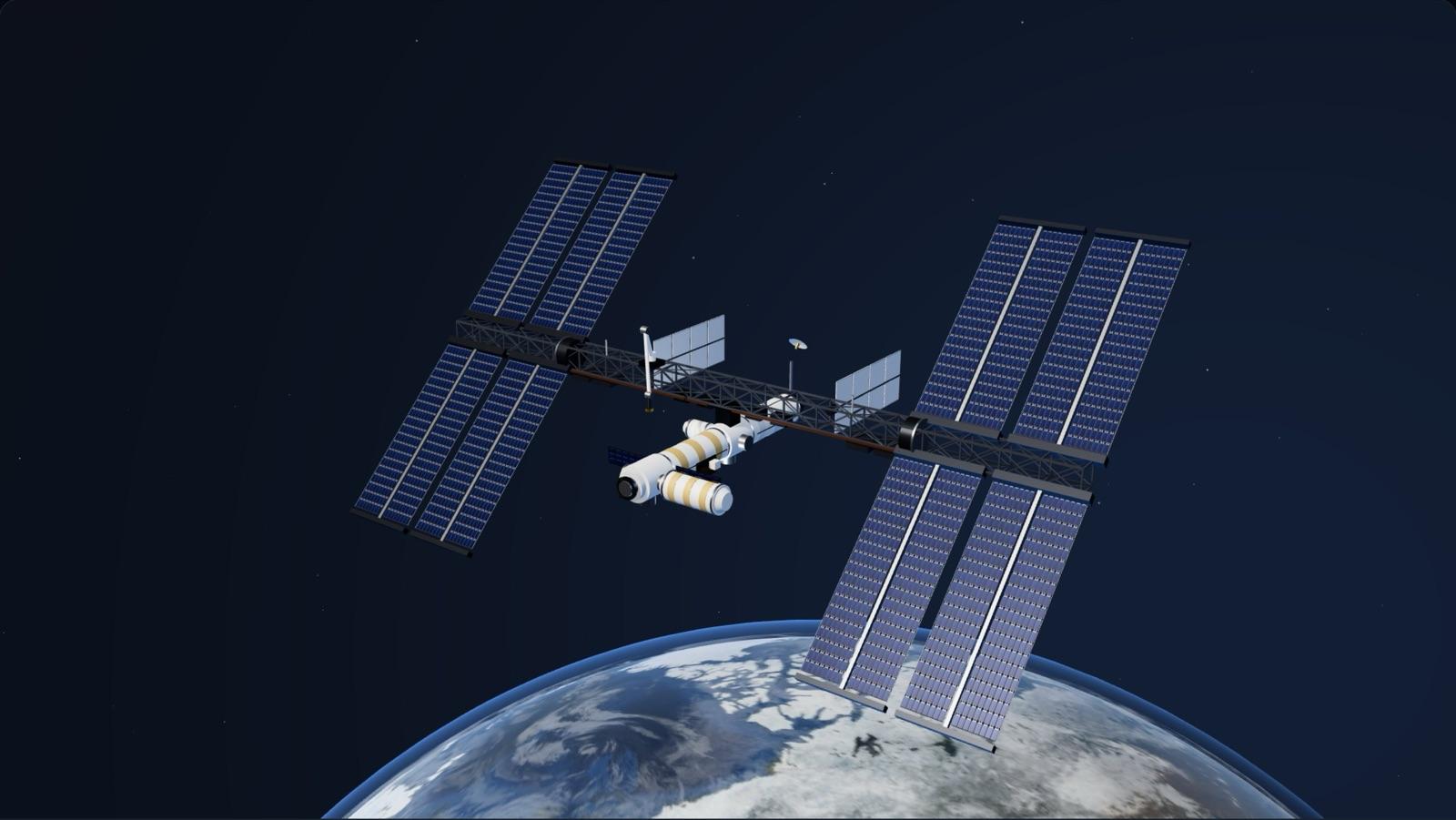
Select a subsystem, or click the model, to inspect it. Drag sideways to turn the station.
Station model, stage 1 of 4: The station in orbit
Model assumptions and limits
- Station Reference Case SRC-1 is a conceptual station, not modelled on any real station. All parameters are illustrative and unvalidated.
- Circular 400 km orbit at β = 0°, the longest eclipse: 92.6 min period, 36.1 min in shadow (cylindrical shadow model).
- 4 power channels of 40 kW while sunlit, sun-tracking, no self-shadowing or seasonal β variation; zero output in eclipse.
- Regulation and distribution efficiency 90 %, charge efficiency 95 %, 180 kWh usable storage, charge taper above 95 % SOC. The same energy-balance step as the published 6U reference case, with these station parameters.
- Constant grouped loads: 40 kW critical, 16 kW essential, 18 kW deferrable research (74 kW in total). Thermal load is estimated as load ÷ efficiency; there is no thermal model.
- Health rule: channel residual (measured against expected power) above 20 % on 5 consecutive 1-minute samples. The protective response applies a fixed load-priority table 2 minutes after detection.
- Projected orbit margins: +11.3 % nominal, −8.2 % with channel 2 degraded, +13.3 % after load priority.
- Visual proportions are approximate; the Earth is drawn large and close, not to scale.
Fault detection and the protective response are deterministic engineering rules, not trained AI. The fault is injected into the simulation only; nothing here connects to any real control system.
What you will learn
A technical competency pathway.
For engineers, scientists and technical leaders. A proposed pathway for research competence, not a set of formal courses: each domain is learned through modelling and experiments.
Level 1
Understand
Space station architecture, orbital mechanics, mathematics, subsystem engineering, interfaces and requirements.
Level 2
Model
Physics, numerical simulation, electrical models, thermal models, environmental models and digital twin architecture.
Level 3
Investigate
Telemetry, diagnostics, anomaly detection, fault propagation, system health, predictive analytics and uncertainty.
Level 4
Verify
Integration, validation, software- and hardware-in-the-loop testing, mission assurance, safety engineering and scientific reproducibility.
01Space Station Systems Engineering
- Required prerequisites
- An engineering or physical-science degree, or equivalent professional experience.
- Skills to acquire
- Requirements, interface definition, trade studies, mass/power/thermal/data budgets, technical reviews.
- Engineering tools
- Model-based systems engineering (SysML), requirements management, Python or spreadsheets for budgets.
- Core theory
- Systems engineering life cycle, the V-model, margin policy, configuration management.
- Practical research exercises
- Build the four budgets for Station Reference Case SRC-1; write the interface definition between power and thermal control.
- Expected deliverables
- System architecture description, budgets and interface definitions.
02Orbital Mechanics and Mathematical Modelling
- Required prerequisites
- Calculus, linear algebra and ordinary differential equations.
- Skills to acquire
- Orbit propagation, eclipse and β-angle analysis, numerical integration and error control.
- Engineering tools
- Python (NumPy, SciPy), MATLAB or Octave, Jupyter notebooks.
- Core theory
- Two-body problem, J2 perturbation, drag, eclipse geometry, Runge–Kutta methods.
- Practical research exercises
- Compute eclipse duration against β-angle; propagate orbital decay and reboost; verify the reference case’s orbit numbers independently.
- Expected deliverables
- An orbit and environment model with verification tests.
03Structural and Modular Systems
- Required prerequisites
- Mechanics of materials, statics and dynamics.
- Skills to acquire
- Pressure-vessel sizing, finite-element analysis, mass-properties tracking.
- Engineering tools
- CAD and open-source finite-element software.
- Core theory
- Thin-wall pressure vessels, structural dynamics, shielding against debris, fatigue.
- Practical research exercises
- Size a module shell for a given pressure; track centre of mass and inertia through an assembly sequence.
- Expected deliverables
- A module structural concept and a mass-properties model.
04Electrical Power and Battery Storage
- Required prerequisites
- Circuit theory and power-electronics fundamentals.
- Skills to acquire
- Photovoltaic modelling, bus design, battery modelling, state-of-charge and state-of-health estimation.
- Engineering tools
- Python, Modelica or Simulink, SPICE circuit simulation.
- Core theory
- Photovoltaic I–V curves, DC–DC conversion, lithium-ion equivalent circuits and ageing.
- Practical research exercises
- Reproduce the Station Reference Case SRC-1 energy balance; inject a channel fault; estimate state of charge from noisy measurements.
- Expected deliverables
- A power simulation, a battery model and an experiment report.
05Thermal and Environmental Systems
- Required prerequisites
- Heat transfer and thermodynamics.
- Skills to acquire
- Thermal networks, radiator sizing, life-support mass balances.
- Engineering tools
- Python, thermal-network solvers, Modelica.
- Core theory
- Radiation exchange, pumped fluid loops, psychrometrics, life-support chemistry.
- Practical research exercises
- Size radiators for the reference load; model cabin CO₂ during a carbon-dioxide removal fault.
- Expected deliverables
- A coupled power–thermal model and a cabin atmosphere model.
06Avionics and Flight Software
- Required prerequisites
- Programming in C, C++, Rust or Python; digital systems.
- Skills to acquire
- Real-time software, data buses, fault tolerance, software verification.
- Engineering tools
- Git, continuous integration, static analysis, simulators, unit-test frameworks.
- Core theory
- Redundancy, deterministic scheduling, software assurance practice.
- Practical research exercises
- Implement and test a telemetry limit check with persistence; build a mode-transition state machine.
- Expected deliverables
- A verified software component with its test evidence.
07Communications and Station Operations
- Required prerequisites
- Signals and systems.
- Skills to acquire
- Link budgets, data handling, operations planning.
- Engineering tools
- Python, link-budget calculators, time-series and telemetry databases.
- Core theory
- RF propagation, modulation and coding, packet telemetry concepts.
- Practical research exercises
- Build a link budget; design a telemetry packet and a replay pipeline for it.
- Expected deliverables
- A telemetry data model and an ingestion and replay prototype.
08Robotics and Docking
- Required prerequisites
- Dynamics and control theory.
- Skills to acquire
- Kinematics, relative motion, contact dynamics.
- Engineering tools
- Python, ROS 2, physics-based robot simulators.
- Core theory
- Denavit–Hartenberg kinematics, Clohessy–Wiltshire equations, impedance control.
- Practical research exercises
- Simulate a visiting-vehicle approach with the Clohessy–Wiltshire equations; compute an arm’s reach envelope.
- Expected deliverables
- An approach simulation and a robotic task model.
09Digital Twin Architecture
- Required prerequisites
- Software engineering and engineering modelling.
- Skills to acquire
- Model integration, co-simulation, data synchronisation, model versioning.
- Engineering tools
- Python, FMI co-simulation, time-series databases, containers.
- Core theory
- Digital model, shadow and twin; synchronisation; uncertainty; model credibility.
- Practical research exercises
- Couple the power and thermal models through a defined interface; replay recorded telemetry into a model.
- Expected deliverables
- A twin architecture document and a working coupled prototype.
10Health Monitoring, FDIR and Prognostics
- Required prerequisites
- Statistics, estimation and control.
- Skills to acquire
- Residual generation, thresholds, Kalman filtering, anomaly detection, remaining-useful-life estimation, explainability.
- Engineering tools
- Python (SciPy, scikit-learn), notebooks.
- Core theory
- Model-based diagnosis, hypothesis testing, Bayesian estimation, fault trees.
- Practical research exercises
- Design a detector for the channel-degradation experiment; measure false alarms against detection delay.
- Expected deliverables
- A detector with ROC and latency evidence.
11Cybersecurity and Mission Assurance
- Required prerequisites
- Networking and software fundamentals.
- Skills to acquire
- Threat modelling, command authentication, data provenance, safety analysis.
- Engineering tools
- Threat-modelling methods, cryptographic libraries, fault-tree tools.
- Core theory
- Confidentiality, integrity and availability; secure boot; hazard analysis; failure tolerance.
- Practical research exercises
- Threat-model the telemetry pipeline; build a fault tree for loss of critical power.
- Expected deliverables
- A threat model, a hazard analysis and a security test plan.
12Research Methods and Technology Leadership
- Required prerequisites
- Grounding in at least one of the domains above.
- Skills to acquire
- Research design, reproducibility, technical writing, technology roadmapping, readiness assessment, peer review.
- Engineering tools
- Git, notebooks, reference managers, LaTeX.
- Core theory
- Hypothesis-driven experiments, uncertainty quantification, verification and validation, technology readiness.
- Practical research exercises
- Write the protocol for one flagship experiment; review another contributor’s results.
- Expected deliverables
- A reproducible experiment package and a technical paper or review.
What you will research
Six R&D programmes.
Two are active priorities. The others are defined research directions without funded teams or active projects yet.
- Active prioritySimulation
Station Power & Energy Intelligence
Generation, storage and distribution models; energy margins through eclipses, degradation and faults; load priority that protects critical systems.
- Active priorityResearch
Integrated Station Health Monitoring
Residual-based detection, isolation and explanation of faults, starting with power-channel and battery health.
- Concept
Integrated Space Station Digital Twin
A modular architecture in which subsystem twins share one environment, one data model and one evidence trail.
- Planned
Thermal & Environmental Intelligence
Coupled power–thermal models and cabin atmosphere mass balances for heat rejection and life-support margins.
- Planned
Robotics, Docking & Operations
Rehearsal models for robotic tasks, visiting-vehicle approaches and station operations timelines.
- Planned
Autonomous Systems and Mission Assurance
Decision support with explainable recommendations, verified against safety requirements before any autonomy is claimed.
Research directions across the programmes
AI for health monitoring Planned
Fault detection, health classification, remaining useful life, predictive models and explainable recommendations. No model is trained yet.
Cybersecurity Planned
Telemetry integrity, command authentication, secure software, data provenance, threat modelling and resilience testing.
Quantum-inspired optimisation Planned
Resource scheduling, power optimisation and station operations planning. No quantum advantage is claimed.
All simulated fault injection stays isolated from real control systems.
What you will develop
From models to reusable engineering products.
What exists today, and what is planned. Research becomes a product only once it is verified and documented.
- AvailableResearchSimulation
Satellite Energy & Telemetry Intelligence
The foundational 6U spacecraft energy and telemetry reference case, with published equations and fault experiments.
See it → - AvailableSimulation
Space Digital Twin
Six interactive 3D experiences: a satellite, a constellation, a spacecraft, a space station, a guided investigation of station power and energy management, and a mission from launch to Earth departure, all driven by simulated data.
See it → - AvailableConceptSimulation
Station Reference Case SRC-1
The station model on this page: a conceptual station with a deterministic energy and health simulation.
See it →
| Deliverable | Status | Where it stands |
|---|---|---|
| Station reference architecture | Started | Station Reference Case SRC-1: a conceptual configuration and its subsystem breakdown, on this page. |
| Electrical power simulation engine | Started | A deterministic orbit energy balance for Station Reference Case SRC-1. A channel-level power-flow engine is planned. |
| Battery energy storage digital twin | Planned | Today only the bulk state of charge is simulated; equivalent-circuit and ageing models are planned. |
| Telemetry ingestion and replay service | Planned | Not yet built. |
| Health monitoring algorithms | Started | A threshold-and-persistence residual rule, in simulation only. Statistical and learned detectors are planned. |
| Fault detection and diagnostic models | Started | One simulated fault case (a degraded power channel). Isolation across subsystems is planned. |
| Station operations simulation | Planned | Not yet built. |
| Research experiment framework | Planned | Hypothesis, assumptions, code, data and review for each experiment. |
| Model validation reports | Planned | No station model has been validated against measured data. |
| Engineering assurance evidence | Planned | Traceability and credibility records for each model. |
Flagship research
Space Station Energy & Health Intelligence
“How can a space station maintain reliable power, protect critical systems and anticipate failures throughout long-duration orbital operations?”
Experiment 1
Nominal station energy balance
- Hypothesis
- With the Station Reference Case SRC-1 arrays and loads, the station returns to full charge every orbit at β = 0° with a positive orbit energy margin.
- Model assumptions
- Circular 400 km orbit, β = 0°, constant grouped loads, sun-tracking arrays, fixed conversion and charge efficiencies, charge taper above 95 % SOC.
- Expected outputs
- Orbit energy margin, state-of-charge trace, end-of-eclipse state of charge, depth of discharge.
- Validation criteria
- Energy closes over each orbit (generated = consumed + losses + change in stored energy) within numerical tolerance; independent recomputation agrees; eclipse duration matches the analytic shadow model.
Experiment 2
Eclipse power management
- Hypothesis
- A scheduled eclipse load plan keeps depth of discharge within a chosen limit across the longest eclipse of the year.
- Model assumptions
- Worst-case β-angle; stated battery capacity; a defined eclipse load plan and its priorities.
- Expected outputs
- Depth of discharge per eclipse, minimum state of charge, energy deferred and research time affected.
- Validation criteria
- Depth of discharge stays below the limit in every simulated eclipse across the β-angle range; results hold under ±10 % battery capacity.
Experiment 3
Solar generation degradation
- Hypothesis
- String-level residuals detect a 10 % loss in one channel within a stated number of orbits at a false-alarm rate below a set limit.
- Model assumptions
- A sensor-noise model, a degradation profile and detection thresholds, all stated before the run.
- Expected outputs
- Detection delay, false-alarm rate and estimated degradation, with uncertainty.
- Validation criteria
- ROC analysis on simulated data with known ground truth; later comparison with hardware-in-the-loop measurements.
Experiment 4
Battery capacity loss
- Hypothesis
- A stated capacity fade can be estimated from routine cycling data within a stated accuracy.
- Model assumptions
- An equivalent-circuit model, an ageing law and a sensor-noise model.
- Expected outputs
- State-of-health estimate with uncertainty, and a projection of remaining useful life.
- Validation criteria
- The estimator converges to the injected capacity in simulation, then is tested against laboratory cell-cycling data before any claim is made.
Experiment 5
Electrical power distribution fault
- Hypothesis
- Priority-based load shedding keeps every critical load powered after the loss of one power channel, with a positive orbit margin.
- Model assumptions
- A channelised bus, a load-priority table and a stated reconfiguration time.
- Expected outputs
- Critical-load availability, orbit margin before and after, research time lost.
- Validation criteria
- All critical loads stay powered in every single-channel-loss case with a positive margin; an independent implementation reproduces the results.
The interactive model runs one case of the last experiment: channel 2 of 4 falls to 30 % output, the projected orbit margin moves from +11.3 % to −8.2 %, and load priority restores it to +13.3 % with all 40 kW of critical loads still powered. Simulated, with illustrative parameters. The experiments themselves are defined but not yet run; results will be published with their evidence.
Skills & research opportunities
Thirteen competency pathways.
The background, knowledge and tools each kind of contribution needs. These are capability pathways for research, not vacancies or offers of employment.
Space Station Systems Engineer
- Required background
- Aerospace, mechanical or electrical engineering; systems experience.
- Technical knowledge
- Architecture, requirements, interfaces, budgets, reviews.
- Mathematics and physics
- Linear algebra, probability, orbital mechanics basics.
- Software tools
- SysML, requirements management, Python.
- Research challenges
- Keeping coupled budgets and interfaces consistent as the design evolves.
- Example work products
- Architecture description, budgets, interface definitions.
Electrical Power Engineer
- Required background
- Electrical or power-electronics engineering.
- Technical knowledge
- Photovoltaics, DC buses, conversion, protection, load management.
- Mathematics and physics
- Circuit analysis, control theory, Fourier analysis.
- Software tools
- SPICE, Modelica or Simulink, Python.
- Research challenges
- Channel-level fault tolerance with the least loss of capability.
- Example work products
- Power-flow models, protection studies, load-priority logic.
Battery and Energy Storage Engineer
- Required background
- Electrochemistry, electrical or chemical engineering.
- Technical knowledge
- Lithium-ion behaviour, charge control, ageing, thermal limits.
- Mathematics and physics
- ODEs, estimation theory, statistics.
- Software tools
- Battery cyclers, equivalent-circuit modelling, Python.
- Research challenges
- Estimating state of health in orbit from routine data.
- Example work products
- Battery models, SOC/SOH estimators, ageing studies.
Thermal / Environmental Systems Engineer
- Required background
- Mechanical or chemical engineering.
- Technical knowledge
- Heat transfer, fluid loops, radiators, life-support chemistry.
- Mathematics and physics
- Heat equation, radiation exchange, mass balances.
- Software tools
- Thermal-network solvers, Modelica, CFD basics.
- Research challenges
- Coupling heat rejection to power use and cabin conditions.
- Example work products
- Thermal networks, radiator sizing, cabin atmosphere models.
Digital Twin Software Engineer
- Required background
- Software engineering or computer science.
- Technical knowledge
- Model integration, data pipelines, versioning, APIs.
- Mathematics and physics
- Numerical methods, discrete mathematics.
- Software tools
- Python, TypeScript, FMI co-simulation, databases, containers.
- Research challenges
- Synchronising many models with data while keeping results reproducible.
- Example work products
- Twin services, co-simulation frameworks, replay tools.
Simulation and Mathematical Modelling Engineer
- Required background
- Applied mathematics, physics or engineering.
- Technical knowledge
- Modelling, numerical simulation, verification, uncertainty.
- Mathematics and physics
- ODEs and PDEs, numerical analysis, statistics.
- Software tools
- Python (NumPy, SciPy), Julia or MATLAB, Jupyter.
- Research challenges
- Fast, verified models with known error bounds.
- Example work products
- Verified simulation models and convergence studies.
Spacecraft Health Monitoring Researcher
- Required background
- Engineering, statistics or control.
- Technical knowledge
- FDIR, residuals, diagnosis, telemetry analysis.
- Mathematics and physics
- Estimation, hypothesis testing, Bayesian inference.
- Software tools
- Python, Kalman filtering, notebooks.
- Research challenges
- Early detection with low false-alarm rates and clear explanations.
- Example work products
- Detectors, diagnostic models, evaluation reports.
AI and Prognostics Researcher
- Required background
- Machine learning, statistics or engineering.
- Technical knowledge
- Anomaly detection, remaining-useful-life estimation, explainability.
- Mathematics and physics
- Probability, optimisation, statistical learning.
- Software tools
- Python, scikit-learn, PyTorch.
- Research challenges
- Learning from scarce fault data and proving what a model can and cannot do.
- Example work products
- Prognostic models with uncertainty and validation evidence.
Flight Software Engineer
- Required background
- Computer or embedded-systems engineering.
- Technical knowledge
- Real-time systems, fault tolerance, software assurance.
- Mathematics and physics
- Discrete mathematics, logic, scheduling theory.
- Software tools
- C, C++ or Rust, RTOS, static analysis, CI.
- Research challenges
- Verifiable onboard health functions within tight resources.
- Example work products
- Verified software components with test evidence.
Cybersecurity Engineer
- Required background
- Security engineering or computer science.
- Technical knowledge
- Threat modelling, cryptography, secure software, provenance.
- Mathematics and physics
- Number theory basics, probability.
- Software tools
- Threat-modelling methods, cryptographic libraries, test tooling.
- Research challenges
- Trustworthy telemetry and commands end to end.
- Example work products
- Threat models, security architectures, test reports.
Mission Operations Engineer
- Required background
- Aerospace engineering or operations experience.
- Technical knowledge
- Timelines, procedures, contingencies, ground systems.
- Mathematics and physics
- Scheduling, probability.
- Software tools
- Planning tools, telemetry displays, Python.
- Research challenges
- Using twin predictions in real operational decisions.
- Example work products
- Operations concepts, procedures, contingency analyses.
Verification and Validation Engineer
- Required background
- Engineering with testing or quality experience.
- Technical knowledge
- Test design, model validation, credibility, traceability.
- Mathematics and physics
- Statistics, uncertainty quantification.
- Software tools
- Test frameworks, hardware-in-the-loop rigs, requirements tools.
- Research challenges
- Showing when a model is good enough for its intended use.
- Example work products
- Validation plans, test reports, credibility assessments.
CTO / Technical Research Director
- Required background
- Senior engineering or research leadership.
- Technical knowledge
- Technology strategy, research portfolios, readiness, risk.
- Mathematics and physics
- Decision analysis, systems thinking.
- Software tools
- Roadmapping, portfolio and risk tools.
- Research challenges
- Turning research into reusable engineering products, truthfully.
- Example work products
- Technology roadmaps, research portfolios, review decisions.
Research roadmap
From foundations to a long-term vision.
Each phase depends on the evidence of the one before it.
2027
Foundations
Station reference architecture, electrical power simulation, battery models and the initial experiments.
2028–2029
Research Integration
Telemetry integration, coupled subsystem models, diagnostics and independent model benchmarking.
2030–2035
Advanced Engineering
Multi-subsystem digital twins, station-level health intelligence and external R&D collaborations.
2036–2047
Long-Term Vision
Trusted, continuously updated digital twins for complex orbital infrastructure, contingent on actual technical and commercial progress.
Questions
Frequently asked questions.
What is the iTelematics Space Station Digital Twin R&D Center?
It is the long-term engineering and scientific research programme of iTelematics Software Private Limited into physics-based, data-driven digital twins for future space stations. The first specialisation is station energy and health intelligence: how a station generates, stores and distributes power, protects its critical systems and anticipates failures.
Does iTelematics build or operate space stations?
No. iTelematics researches the digital engineering that future stations need: models, simulations, health monitoring and assurance methods. It does not build, launch or operate space stations, and it makes no claim of flight heritage.
What is a space station digital twin?
A system-specific, appropriately synchronised and validated digital representation of a station or one of its subsystems, with a defined engineering purpose. It differs from a simulation (a model that predicts behaviour under stated assumptions) and from a digital shadow (a representation updated from measured data without full two-way synchronisation).
Is the interactive station model on this page a digital twin?
No. It is a deterministic simulation of a conceptual station, Station Reference Case SRC-1, with illustrative parameters and simulated values, not flight data. It shows a nominal orbit with an eclipse, then a simulated solar-power fault and a protective load-priority response.
What is Station Reference Case SRC-1?
A conceptual modular research station in a 400 km orbit used as a shared reference for station energy and health research: 4 solar power channels, battery storage and loads grouped by priority, with 40 kW of critical loads. Its projected orbit energy margin is +11.3 % nominal, −8.2 % with one channel degraded and +13.3 % after load priority is applied.
What are the current research priorities?
Two programmes are active priorities: Station Power & Energy Intelligence and Integrated Station Health Monitoring. Integrated digital twin architecture is at concept stage; thermal and environmental intelligence, robotics and operations, and autonomous systems and mission assurance are planned.
How can researchers and organisations collaborate?
Scientists, engineers, research organisations and technical leaders can propose a project, review a model or contribute to an experiment through the Research Lab or the contact page. Taking part does not imply employment, funding, certification or university affiliation.
What is the long-term vision?
To advance the engineering and operational intelligence of future space stations through trusted digital twins that help make orbital infrastructure safer, more resilient, autonomous and sustainable. The horizon is 2047; milestones before then are proposed planning targets, not commitments.
Collaborate on Space Station Digital Twin Research.
Scientists, researchers, engineering organisations and technical leaders can propose a project, review a model or contribute to an experiment. Tell us the problem, your background and the evidence you could bring. Taking part does not imply employment, funding, certification or university affiliation.